Over the long South African 'Heritage Day' weekend, David and I hit the road to Namibia for some adventure and a new stamp in our passports.
The South African - Namibian border is about 8 hours from Stellenbosch. We spent our first day traveling north and watching the scenery change from mountains covered in rain clouds to the dry, sunny desert. We crossed the Orange River, the natural border between the two countries, late that afternoon and rested up for another long day on the road the following day.
We set out bright and early Saturday morning along a long dirt road that hugged the Orange River before heading up toward the town of Aus. Aus is known for a herd of over 100 wild horses, possibly abandoned by the German army during the first World War. We were lucky enough to catch them just at the right time as they crossed over the road, one by one, in front of us.
After watching these horses for a couple of hours, we continued on our way, through the wind and sand, to the coastal town of Lüderitz.
Sunday we visited the ghost town of Kolmannskuppe, a German diamond mining town abandoned over 50 years ago when bigger and better diamonds were found further south. It was absolutely amazing to walk through these houses and town buildings that were once full of life but now are only home to sand dunes and a few desert animals.
The next day we took the long road back to the border so that we could swing by the Fish River Canyon. It is the second largest canyon in the world; second only to the Grand Canyon.
I even learned to drive our standard rental car as we took in all the sights of southern Namibia. For a spur-of-the-moment and relatively short trip, our Namibian adventure far exceeded our expectations.
Showing posts with label African Adventure. Show all posts
Sunday, October 27, 2013
Wednesday, August 21, 2013
{African Adventure} Rotary Presentations
During
our trip to Tanzania, we were able to deliver our first Ambassadorial Scholar
presentations outside of South Africa. The first was to the kids at Amani
Children’s Home in Moshi, Tanzania. We gave a presentation about Texas (with
the assistance of our Swahili translator) and taught the kids how to sing “Deep
in the Heart of Texas.”
After
the presentation, we organized a rodeo that included races with broom horses
and balloon cows. However, the kids enjoyed an old fashion sack race the most!
I
delivered our second presentation in Tanzania to the Marangu Rotary Club
located just outside of Moshi at the base of Mt. Kilimanjaro. In fact, I gave
the presentation at the Marangu Hotel which is a popular launching spot for
treks up the mountain. During the presentations, I share a little about my
family, my hometown, sponsor Rotary club, Texas, Rotary service projects and my
studies at Stellenbosch University.
Monday, August 19, 2013
{African Adventure} Jackpot Safari
After a fun week with the kids at Amani Children's Home, David and I set out on another adventure for a four day safari with Jackpot Safaris.
We met up with our wonderful guide, Derick, and gourmet chef, Waziri, at their office in Arusha and headed out towards Lake Manyara National Park. Once we arrived, we popped up the roof and were in true safari spirit with our binoculars and camera ready for any and every animal we might spot! We saw many animals on our first day including monkeys, zebras, giraffes, hippos, and a few different antelopes.
By far the highlight of my day was when we came up on a large herd of forest elephants! We had been on the hunt all day and just as we were heading towards the gate, we spotted them. There must have been at least 15 elephants, young and old, all around our truck!
After a fun first day, we headed back to camp to a delicious meal and entertaining "acrobatic show" before heading to bed. We woke up early the next morning to a beautiful sunrise, met up with a French couple who joined us for the day, and off we went towards the Ngorongoro Crater. Ngorongoro Crater is the largest unbroken caldera in the world and is home to over 30,000 animals - almost half of which are zebra and wildebeest. Just as we pulled in we came on a herd of zebra and wildebeest as far as the eye could see. We also spotted water buffaloes, a lonely male elephant, a few lionesses napping, hippos, and hyenas.
As we were eating lunch, Derick heard a few other guides talking about a rhino spotting. Seeing a rhino on your safari is kind of a big deal - there are only 30 left (due to severe poaching) in Tanzania and those 30 are all in the crater. So we hurried back in the car and Derick took off towards the long line of safari vehicles in hopes that we could spot a rhino for ourselves. He was a little ways off but still awesome to see.
After a little animal spotting that afternoon, we dropped off our French friends and headed back to camp. The next morning we woke up in the clouds and left early for our trip to the Serengeti National Park. "Serengeti" means "endless plains" in the Masai language and around 35 different species of animals - including the "Big 5" - can be spotted here. Not long after we entered, we came across a beautiful cheetah followed by a few giraffes, elephants, gazelles.
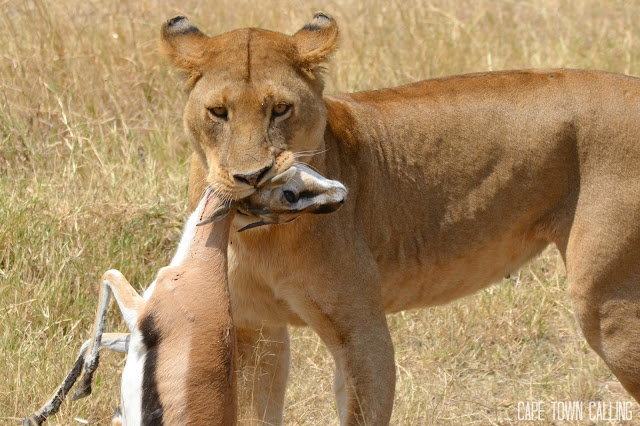
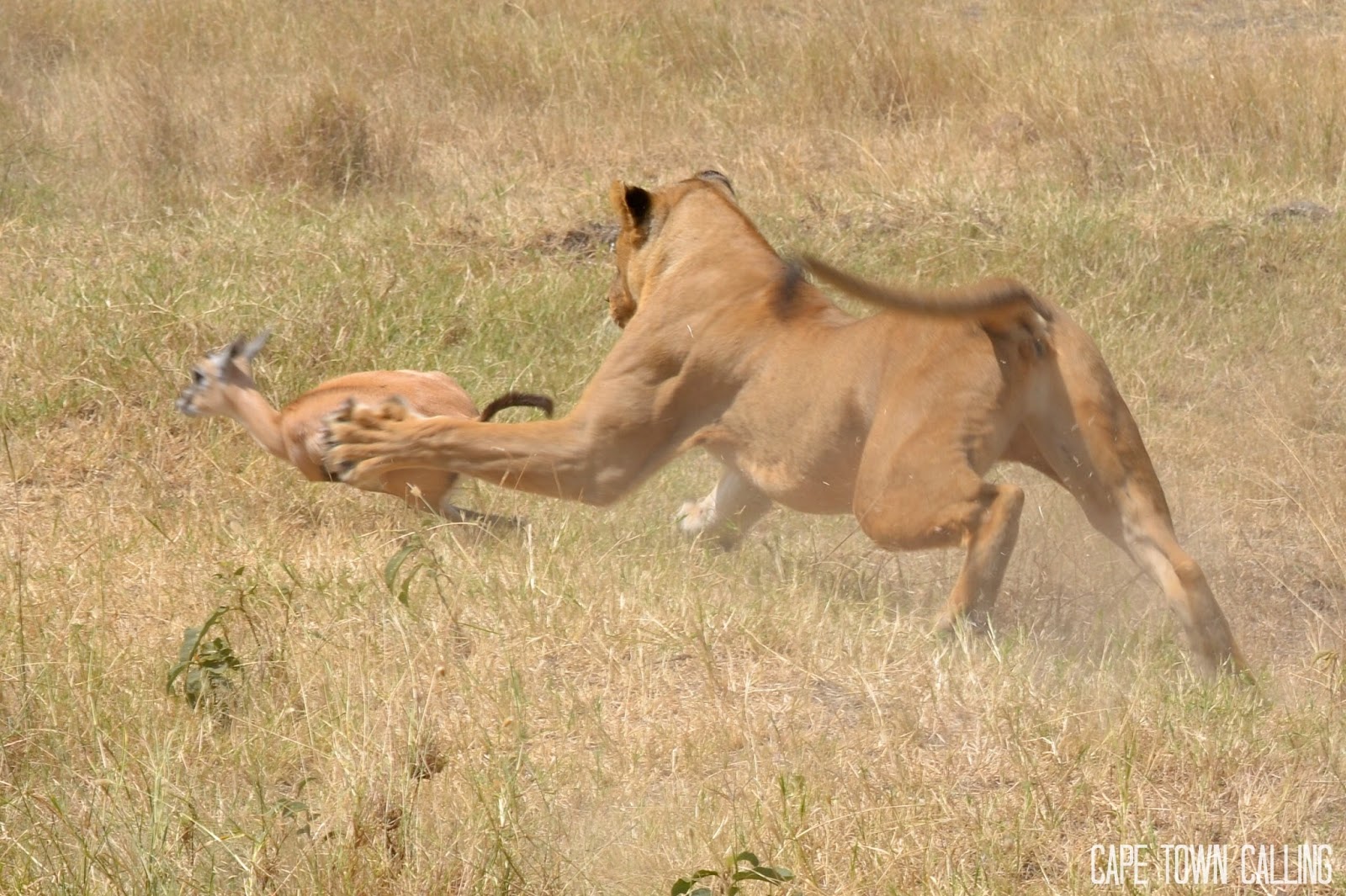
We later came up on the most amazing part of our entire safari! We noticed a long line of cars watching a lioness who seemed to be stalking something. Derick took a short cut through a mud hole and made a way right up in to the middle of the action. The couple in the car behind us shot us a few dirty looks for interrupting with our loud truck. The lioness was tucked down in the grass stalking a little thompson gazelle. The gazelle moved out of sight towards the watering hole and the lioness slowly creeped right past our truck. The gazelle then tried to make a run for it between our truck and the one in front but missed and ran smack dab in to the tire of the other truck. This stunned the gazelle just long enough for the lioness to come in and take the last swing to grab a hold of her snack. Although not a thing I normally like to see, this was absolutely incredible to watch - and only 3 meters or so in from of us! I'm sure the couple behind us were really sending a few ugly looks our way after we blocked their view of the entire show - but we didn't turn around to check!!
We took a siesta that afternoon at camp and then headed back out for a sunset drive in hopes of finding more big cats. We first spotted a few giraffes and then came across a lioness laying on the edge of the road. After watching the gorgeous sunset over the plains, we headed back for our last supper with Derick and Waziri.
The next day we went for an early morning drive in hopes to spot a leopard but no such luck. But 4 out of the 'Big 5" makes for a very successful safari! We had an absolute blast and would recommend Jackpot Safaris to anyone interested in going - just ask for Derick and Waziri!!
Friday, July 19, 2013
{African Adventure} Kilimanjaro Coffee Tour
Another fun adventure we had in Moshi was a day on the lower slopes of Mount
Kilimanjaro for a coffee tour with Kahawa Shamba. The coffee tour took us
through a local farming village and we had the chance to experience the whole
process of coffee production from bean to cup.
We arrived early in the morning to a brisk and cool day on the mountain. We sat down to warm up with a fresh brewed cup of local coffee and met our guide, Mike. The local farmers rotate as guides for the tours which bring in a little extra income for their families and community as a whole.
After shelling the berries, they soak the beans for 24 hours to separate the
good beans, which sink, from the beans with disease, which float. Then the beans are then laid out to dry for
14 days. They once again sort out any bad or discolored beans to ensure only
the best beans are sent for roasting.
The next step is to remove the second skin, or the husks, of the beans by pounding them using a wooden mortar and pestle. After this, the beans are ready for roasting in a small clay pot over a hot fire.
We very much enjoyed our tour of the Kahawa Shamba Coffee Farm. Mike gave us
a few beans to plant so hopefully, we can start growing some of our own fresh
coffee when we return home later this year!
We arrived early in the morning to a brisk and cool day on the mountain. We sat down to warm up with a fresh brewed cup of local coffee and met our guide, Mike. The local farmers rotate as guides for the tours which bring in a little extra income for their families and community as a whole.
We then set out down the slopes to a small cluster of homes where we
would begin learning about the process of making coffee. Mike started
by showing us how they plant a couple of beans in a small plastic bag
and then, after a few weeks, transplant the coffee plants to the fields
under the shade of banana trees. Then we began picking ripe berries from
a tree nearby and took them to a machine to remove the outer shell.
The next step is to remove the second skin, or the husks, of the beans by pounding them using a wooden mortar and pestle. After this, the beans are ready for roasting in a small clay pot over a hot fire.
We then put the roasted beans back in the mortar and pestle and ground them
to a fine powder before brewing the freshest cup of coffee we had ever tasted.
Subscribe to:
Posts (Atom)